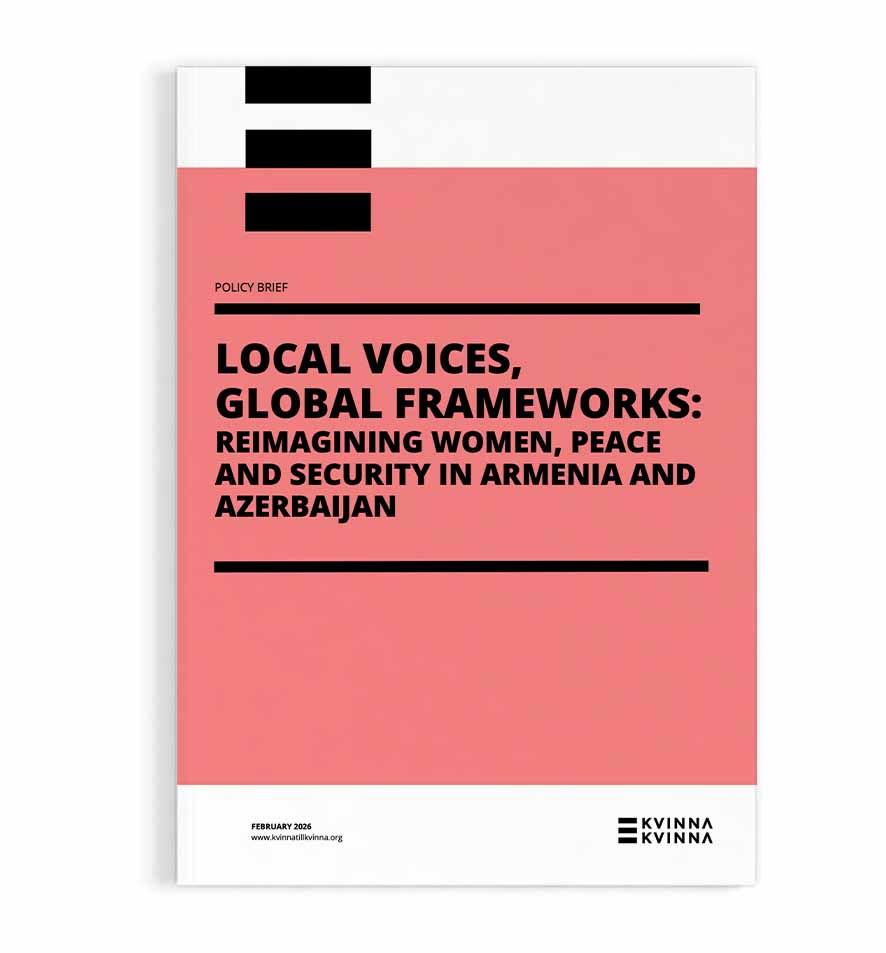
Local voices, global frameworks

Reimagining women, peace and security in Armenia and Azerbaijan

Local voices, global Frameworks: reimagining women, peace and security in Armenia and Azerbaijan examines how the Women, Peace and Security (WPS) agenda is experienced and understood by women living with the consequences of the Armenian‑Azerbaijani conflict.

Drawing on interviews and focus group discussions with women in Armenia and Azerbaijan, including displaced women, frontline residents, women human rights defenders and queer activists, the report explores the gap between global policy frameworks and local realities. It analyses the implementation of UNSCR 1325 and national action plans, highlighting both their limitations and their potential as tools for accountability.

The report calls for more locally grounded, inclusive and feminist approaches to peacebuilding that reflect women’s lived experiences and priorities.

Download the report in English (pdf) »

Policy recommendations

  • Participation

    Grassroots women’s organisations, displaced women, youth, queer people and women from marginalised groups should be enabled to define priorities and participate safely and meaningfully. This requires long‑term, flexible and accessible funding, as well as formal recognition of women’s lived experience as expertise equal to that of diplomats and negotiators. Women’s meaningful participation must extend beyond symbolic inclusion to influence decision‑making across formal and informal peacebuilding spaces.

  • Protection

    Protection systems that respond to women’s everyday insecurity, including conflict‑related violence, domestic violence and shrinking civic space must be strengthened. Crisis preparedness, early‑warning mechanisms, shelters and community‑based responses should be inclusive and gender‑sensitive, drawing on women’s experiences of past crises. Special attention is needed for women human rights defenders and peacebuilders facing heightened risks, including access to rapid protection measures such as legal assistance and relocation support. Mental health and psychosocial support must be recognised as core protection needs, particularly for displaced and conflict‑affected women.

  • Prevention

    Invest in prevention strategies that reduce militarisation and enable societies to imagine futures beyond war. This includes supporting women’s rights, youth engagement, education and socio‑economic opportunities that challenge conflict‑driven identities. Joint educational and social initiatives can create pathways for coexistence beyond formal peacebuilding, while peace education, particularly in schools, can disrupt narratives of enmity from an early age. Prevention efforts should strengthen local capacity, reduce dependency on external actors and support women’s roles in education and community leadership as foundations for long‑term peace.

  • Relief and recovery

    Ensure recovery processes are inclusive, gender‑responsive and shaped by the experiences of women affected by displacement and prolonged insecurity. Recovery must go beyond infrastructure to address housing, livelihoods, social protection and psychosocial needs, while removing discriminatory barriers that limit women’s access to support. Women’s unpaid labour and leadership during conflict and displacement should be recognised and valued in post‑conflict planning. Particular attention is needed for marginalised women, including those with disabilities and LGBTQ people, whose needs are often excluded from recovery frameworks and assistance programmes.

More publications