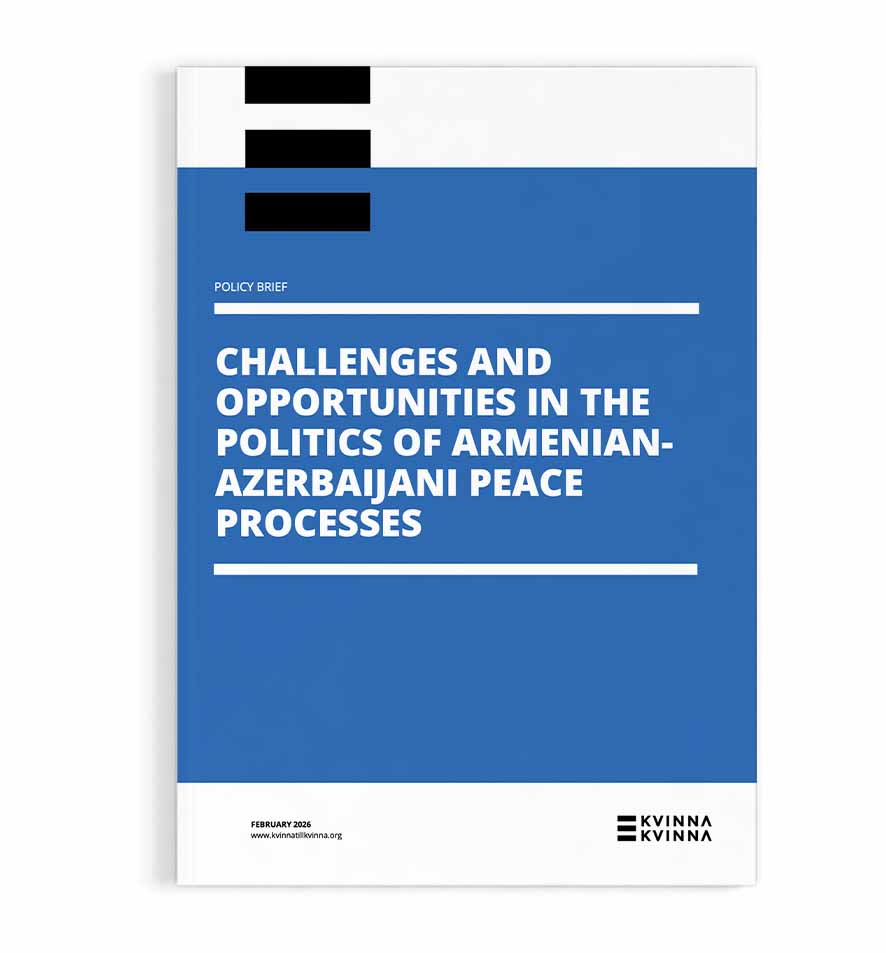
Challenges and opportunities in the politics of Armenian-Azerbaijani peace process

Building on more than two decades of work supporting women’s rights defenders and women peacebuilders in the South Caucasus, Challenges and Opportunities in the Politics of Armenian-Azerbaijani Peace Process examines women’s perspectives on the evolving peace and conflict transformation processes in Armenia and Azerbaijan. It follows Kvinna till Kvinna’s 2019 report Listen to her, which explored the gendered impacts of the conflict over Nagorno‑Karabakh and women’s priorities for peace.

Since then, the context has shifted significantly, shaped by renewed war in 2020, the mass displacement of Armenians from Nagorno‑Karabakh in 2023 and the announcement in 2025 that Armenia and Azerbaijan had agreed on the text of a peace deal.

Drawing on interviews and focus groups, the report analyses how these developments are experienced at the societal level and presents findings and recommendations to European political actors, particularly EU institutions and Member States, to support more inclusive and sustainable peacebuilding.

Download the report in English (pdf) »

Policy recommendations

  • Ensure inclusive and transparent peace processes

    Ensure greater transparency and inclusivity in Armenian‑Azerbaijani peace negotiations to build trust and reduce insecurity among conflict‑affected communities. Many women reported limited access to information about peace talks, contributing to fear and mistrust. Structured mechanisms for public dialogue are needed so that people, particularly women, displaced communities and women human rights defenders, can engage with and influence peace processes. Information should be shared proactively in accessible formats and reach beyond political and urban centres. Inclusive platforms can counter misinformation and help ensure negotiations reflect lived realities rather than elite priorities, strengthening the legitimacy and sustainability of peace outcomes.

  • Put people at the heart of peacebuilding

    Put human security, rights and social cohesion at the centre of peace processes, rather than prioritising geopolitical or economic interests. Many women perceived current negotiations as transactional, focused on state power, infrastructure and business gains while overlooking everyday insecurity, trauma, displacement and inequality. Peacebuilding should be guided by conflict‑, gender‑ and context‑sensitive analysis that addresses historical grievances and social divisions alongside political and territorial issues. International actors, including the EU and its Member States, should ensure that development cooperation and business engagement uphold human rights and gender equality, supporting inclusive societies rather than elite interests alone.

  • Address gender gaps in peacebuilding

    Address gender gaps by ensuring women’s meaningful participation in all stages of peacebuilding and mediation. Women bring critical contextual knowledge through their work with communities most affected by conflict, displacement and insecurity, yet remain marginalised in formal processes. Engagement should be regular and inclusive of women from diverse backgrounds, including displaced women, grassroots activists and women human rights defenders. Safe spaces are essential to enable women to participate openly within and across conflict‑affected societies, particularly where civic space is shrinking. International actors should actively draw on women’s expertise, including their conflict analysis and early‑warning insights. Ensuring women’s participation is a core requirement for inclusive and sustainable peace processes.

More publications