When AI becomes a weapon—new threats to women and human rights defenders
AI can be used to cure diseases and create new opportunities. But the same technology can also be used for surveillance, control and warfare. For women, activists and human rights defenders, these developments bring new threats—both on the ground and online.
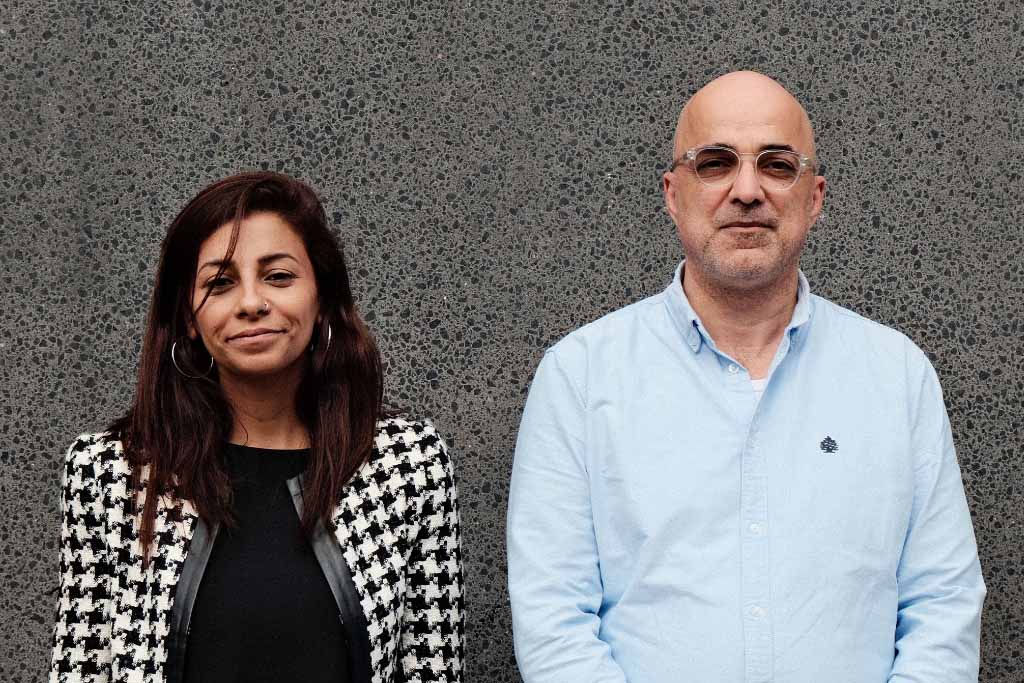
The Palestinian organisation 7amleh – The Arab Center for the Advancement of Social Media, works to highlight the problems brought about by new AI technology.
“We monitor digital rights, help activists and civil society organisations with digital security, and try to influence both decision-makers and major technology companies,” says Nadim Nashif, founder and executive director of 7amleh.
When Nadim Nashif and Lama Nazeeh from 7amleh (pronounced “Hammle”) visited Kvinna till Kvinna’s office in Stockholm in September 2026, they described how AI and digital surveillance are rapidly changing the conditions for human rights defenders.
“The technology used related to the occupation of Palestinians by Israel can also have consequences around the world”, says Nadim.
AI as warfare
“AI has become part of modern warfare. Systems can analyse enormous amounts of information, identify people and vehicles, and be used for targeting,” says Nadim.
Nadim describes the development as a new level of warfare. According to him, Israel has access to advanced technology for facial and vehicle recognition, automated weapons systems, targeting and extensive surveillance.
“This is a new standard of warfare. The extensive use of AI is the reality we are struggling with,” says Nadim.
According to 7amleh, different AI systems are used for military purposes in Gaza, while in the West Bank the technology is largely used for surveillance and control of people’s movements.
For Lama, who works with advocacy at the organisation, the question is not whether to be for or against AI. What matters is how the technology is used.
“Ultimately, we want AI to be able to cure cancer and move us forward. The question is whether we are developing AI to promote human rights and human development—or AI that is used to kill people,” she says.
Facial recognition and control of freedom of movement
In the West Bank, AI and biometric technology are used at checkpoints and in surveillance systems, among other things. Facial recognition cameras can register and track people’s movements, Nadim explains.
Nadim and Lama describe how surveillance is not only directed at individuals but can also be used to control entire communities. In practice, the technology can affect people’s ability to get to places such as schools or hospitals.
For 7amleh, this development is also an international issue. Technology used in Israel and Palestine can later be exported and used in other parts of the world, for example for border and migration control.
Surveillance follows people into their homes
Surveillance does not always stop in the street. Lama describes cameras that are directed at private homes and can capture what is happening inside.
“For women and girls, this can have particular consequences. Women who wear the hijab may feel that they are not safe even in their own homes. That they do not have any private space where they can safely take off their hijab. If you want to undermine a community, you start with women and girls,” says Lama.
7amleh also sees how attacks against women begin online. Women and human rights defenders are subjected to harassment, smear campaigns, and the manipulation or sharing of private images. The organisation therefore works to educate and empower women in digital security.
AI makes digital attacks easier
AI can be used to create deepfakes, fake images, automated accounts and disinformation campaigns. According to Nadim and Lama, the technology is also becoming cheaper and more accessible. This means that more people can create convincing false material or use the technology to target an individual.
“Women and women’s rights defenders along with other vulnerable target groups are being targeted by AI-based smear campaigns. The attacks may be politically motivated, but they can also take place on a personal level, for example through the sharing of intimate images or the creation of fake images,” says Lama.
7amleh provides support to people whose accounts have been hacked or whose phones have been subjected to surveillance, and helps people affected by digital attacks.
Social media—both a threat and a lifeline
At the same time as activists are exposed to digital threats, social media is essential for documenting, organising and reaching people, Nadim explains.
“We are seeing growing self-censorship among Palestinian users. People weigh their words and think about what they dare to publish. At 7amleh, we defend hundreds of accounts that have been shut down and help users appeal the decisions,” says Nadim.
Nadim therefore describes social media as a space that activists cannot abandon.
“We cannot withdraw from social media. Creating and sharing content is one of the few ways to show what is happening. Social media is a way for us to defend ourselves,” says Nadim.
This makes the digital space contradictory: the same platforms where activists risk harassment, surveillance and account shutdowns are also essential for enabling their stories to reach the outside world.
“Platforms need to take responsibility”
7amleh also argues that social media platform owners need to take greater responsibility. The organisation documents content and reports accounts and other problems to the platforms, but stresses that action often only happens after repeated pressure from civil society.
“Platforms need to take responsibility for their own work. We keep submitting reports about accounts that are taken down for no reason, and findings from our research, and then they act—but it does not happen by itself. We want stronger accountability from technology companies”, says Nadim.
“A world without AI regulation is a dangerous world”
For 7amleh, an important part of the work is to influence how AI and other technologies are regulated. The organisation wants to see greater responsibility from both states and technology companies and clearer limits on how these systems can be used.
“A world without AI regulation is a dangerous world,” says Nadim.
Despite surveillance, digital attacks and shrinking space for human rights organisations, 7amleh continues its work.
“We will continue to defend human rights and people’s digital rights and support people to make their voices heard, says Nadim.