Strengthening regional responses to gender backlash in the Western Balkans
Against a backdrop of increasing polarisation and growing attacks on gender equality and human rights, women’s rights organisations from across the Western Balkans gathered in Skopje in February 2026 for a regional networking and exchange meeting. The meeting was organised by The Kvinna till Kvinna Foundation with support from the UK’s Foreign, Commonwealth & Development Office.
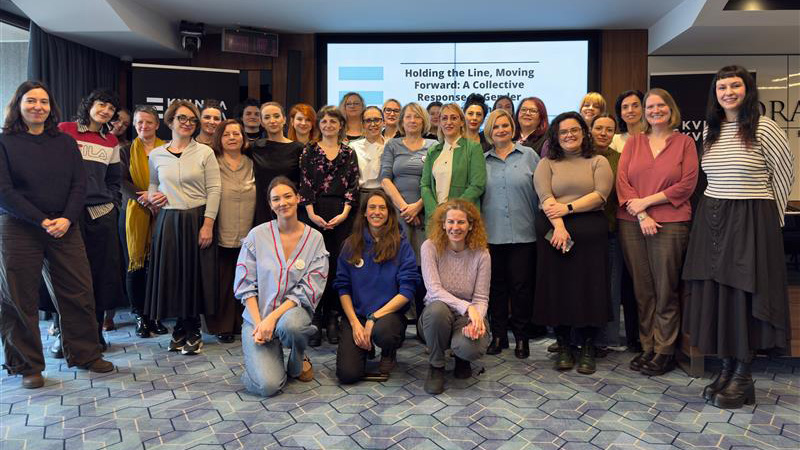
Globally, anti-democratic narratives are gaining political traction, democratic institutions are under pressure and public debate is increasingly polarised. Across many countries, hard-won rights and reforms are being openly challenged and reframed as controversial.
In this environment, 19 women’s rights organisations from Albania, Bosnia and Herzegovina, Kosovo, Montenegro, North Macedonia and Serbia came together to exchange lessons from practice and refine strategic approaches to the backlash. Held under the title “Holding the Line, Moving Forward: A Collective Response to Gender Backlash,” the meeting focused on analysing current political trends and strengthening coordinated responses across the region.
Civil society and democratic resilience
Opening the meeting, Ristin Thomasson, Regional Director for the Western Balkans at Kvinna till Kvinna, addressed the accelerating global backlash against women’s and human rights. She noted that women’s rights organisations are often the first to experience shrinking civic space and intensified public scrutiny, yet continue to drive reform efforts and hold institutions accountable. The meeting, she emphasised, was intended to strengthen cross-border cooperation and sharpen strategic responses to these pressures.
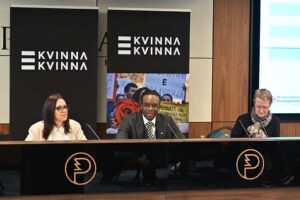
Voskre Naumoska Ilieva and Ristin Thomasson (Kvinna till Kvinna) and Tobi Oshilaja (British Embassy Skopje) delivering opening remarks at the Meeting. Photo: Maja Janevska-Ilieva
Tobi Oshilaja, Head of Programmes at the British Embassy in Skopje, highlighted the essential role that civil society organisations play in upholding institutional stability and fostering social cohesion. He emphasised that promoting equality and inclusion is not only a core value but also a vital component of democratic resilience and security. He further reaffirmed the UK’s dedication to working closely with civil society to strengthen inclusive governance.
Regional coordination to counter the backlash
During the three-day meeting, exchanged experiences from ongoing advocacy efforts, including reforms related to gender-based violence, criminal law and gender equality legislation. While important legal advances have been achieved across the region, these reforms are increasingly facing political resistance and attempts at rollback.
Discussions highlighted recurring challenges: political resistance despite formal commitments, equality framed as controversial in public debate, and reforms vulnerable to backlash when not accompanied by sustained communication and coalition-building. Participants emphasised that legal change alone is insufficient without strategic positioning and institutional follow-through.
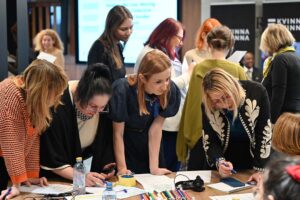
Participants engaging in group discussions. Photo: Maja Janevska-Ilieva
Strategic communication therefore emerged as a central focus. In polarised media environments marked by disinformation, framing shapes public perception before substantive debate even begins. Partners reflected on how advocacy strategies must adapt—identifying credible messengers, choosing appropriate forums for engagement and calibrating responses in increasingly fragmented public spaces.
The exchange also allowed for alignment on shared regional priorities, including tackling gender-based violence, strengthening protection for human rights defenders, responding to hostile narratives around gender equality and safeguarding sustainable support for feminist civil society. By refining approaches collectively, partners strengthened their capacity to respond to political pressure across the Western Balkans.
The Regional Networking and Exchange Meeting was part of the Democracy and Resilience in the Western Balkans—Supporting Feminist Change Agents 2.0 programme, which aims to strengthen feminist civil society and democratic accountability across the region. As political environments continue to evolve, sustained regional coordination, strategic clarity and cross-border solidarity remain essential to ensuring that legal commitments translate into meaningful and lasting change.